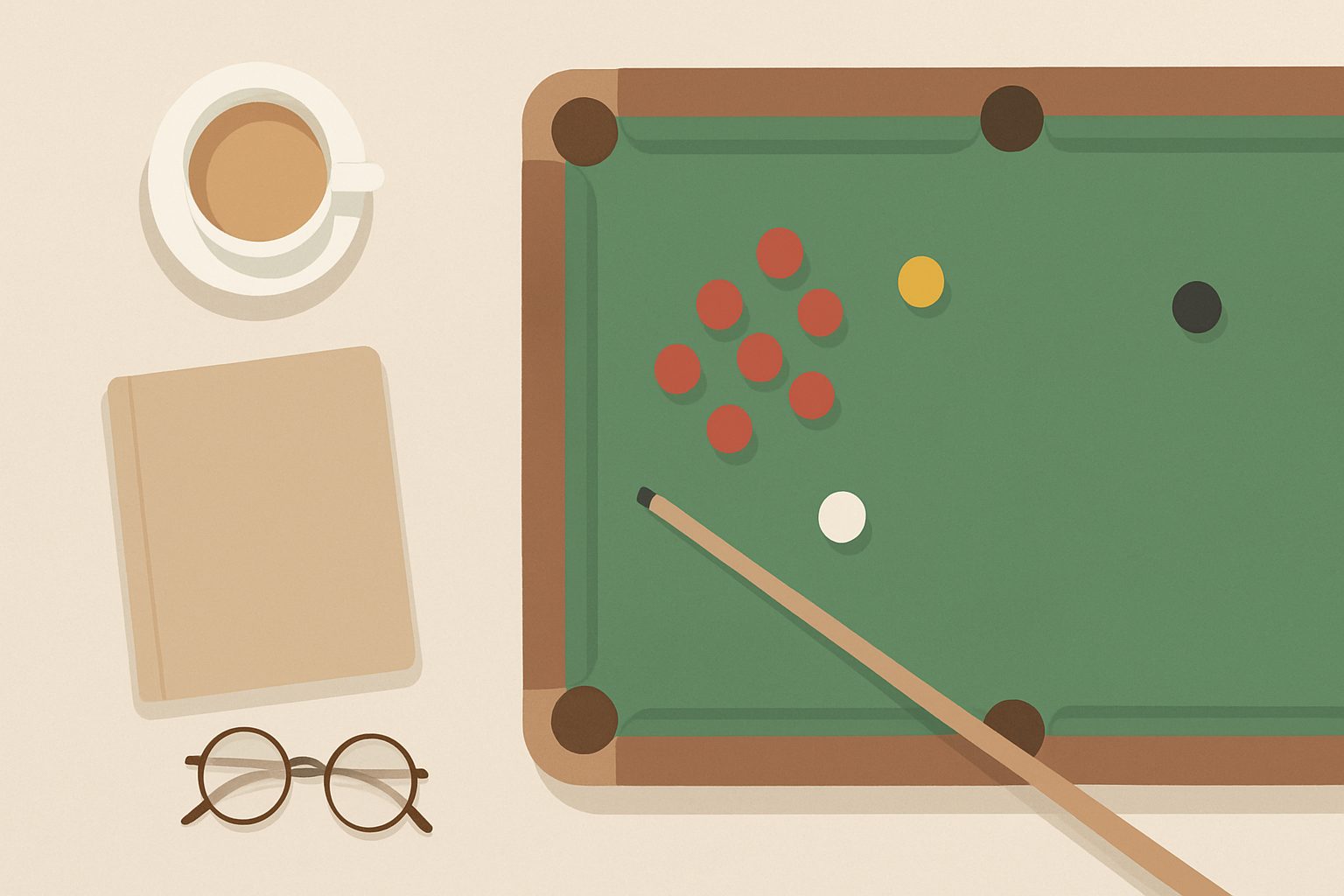
What Size Snooker Table Do I Need? UK Room Size Guide & Calculator
Choosing the right snooker table size for your home comes down to one brutal truth: the table itself isn't the problem—having enough space around it is. You need room to move, shoot comfortably, and actually play the game, not just squeeze in a table and stare at it. Most people underestimate how much space a snooker table really demands.
This guide walks you through the standard sizes available in the UK, how much floorspace you actually need, and the practical trade-offs between full-size, three-quarter, and smaller tables.
Standard Snooker Table Sizes
Snooker tables come in a fixed set of dimensions, and these are governed by world championship standards. The slate playing surface itself doesn't shrink—snooker rules demand exact dimensions. What does vary is how much margin the manufacturer includes around the cushions.
Full-size (12ft × 6ft) — This is the only size used in professional snooker. The playing surface is 11ft 8in × 5ft 10in, and the table frame adds about 6 inches on all sides. Total dimensions are roughly 12ft 6in × 6ft 6in, depending on the manufacturer. If you want to play by genuine rules, this is the only real choice. However, it requires significant space.
Three-quarter size (10ft × 5ft) — Popular for serious home players who can't fit a full-size table. The playing area is proportionally smaller, and the overall footprint is typically around 10ft 6in × 5ft 6in. You get a more compact game, though the angles and distances feel noticeably different.
Smaller leisure tables (7ft–8ft) — Sometimes called "bar box" or "pool table" dimensions. These are increasingly common in homes but aren't actually snooker—they're scaled-down versions meant for casual play. The ball sizes and pocket dimensions are different. Worth knowing the distinction if you're serious about the sport.
How Much Space Do You Actually Need?
This is where people go wrong. You don't just need the table's footprint; you need space to use a cue.
A snooker cue is typically 4ft 8in to 4ft 10in long, though some players use shorter 4ft 6in variants. In practice, you need at least 4ft 6in of clear space behind where you'll stand to play most shots. If you're playing along the length of a full-size table, you might shoot from either end, so add 4ft 6in clearance at both ends as well.
Quick calculation for a full-size table:
- Table footprint: 12ft 6in × 6ft 6in
- Add 4ft 6in clearance on each end (along the length): +9ft
- Add 2ft clearance on each long side (minimal but advised): +4ft
- Total working space: roughly 21ft × 10ft 6in
That's a large room. Many UK homes don't have a single space that size.
For a three-quarter table (10ft × 5ft):
- Table footprint: 10ft 6in × 5ft 6in
- Add 4ft clearance on each end: +8ft
- Add 2ft on long sides: +4ft
- Total working space: roughly 18ft 6in × 9ft 6in
Still substantial, but more achievable in a dedicated games room or extended kitchen-diner.
Measuring Your Room
Before you commit to a table, measure your actual space, including architectural awkwardness. Standard dimensions don't account for:
- Alcoves, fireplaces, and jutting walls — These steal usable space that your measurements might miss.
- Door swings — The door to your room needs to open fully without hitting the table or blocking your position.
- Lighting and radiators — Ceiling lights need to clear the cue swing (at least 8ft height is ideal); radiators along walls reduce usable area.
- Existing furniture — Sofas, cabinets, or tables reduce your playing angles.
Honestly assess the longest unbroken sightline in your room. This should be at least 15ft for a three-quarter table, 18ft for full-size.
The Trade-Off: Space vs. Genuine Play
Here's the honest conversation: a full-size table in cramped conditions isn't the same as a full-size table in proper space. You'll be limited on shot angles, forced to make awkward bridges, and frustrated by shots you can't make because there isn't room to position yourself. A three-quarter table in adequate space will give you more enjoyable play than a full-size table where you're constantly bumping walls.
If you can commit to ~21ft of length and ~10ft of width with minimal obstruction, a full-size table is genuinely worth the investment and will hold its value well. If your space tops out at 18ft of usable length, a three-quarter is more practical. If you're under 15ft, you're genuinely better served by a smaller leisure table or accepting that snooker might not be the right game for a home setting.
Next Steps
Once you've measured your room and settled on a table size, it's worth reading through detailed reviews of specific tables in your chosen dimension. Full-size tables vary significantly in quality and price, and the same applies to three-quarter sizes.
If a full-size table is possible but you're still unsure, measure your space again—seriously, people often underestimate clearance. Then consider whether you can live with the learning curve and ongoing maintenance (slate tables need regular levelling and cloth replacement).
More options
- Home Snooker Tables (All Sizes) (Amazon UK)
- Slate Bed Snooker Tables (Amazon UK)
- Snooker Table Accessories & Bundle Sets (Amazon UK)
- Snooker Cue Sets (Amazon UK)
- Snooker Table Cloth & Re-Clothing Kits (Amazon UK)